The 20-Year-Old File Format That Became the Language AI Understands Best
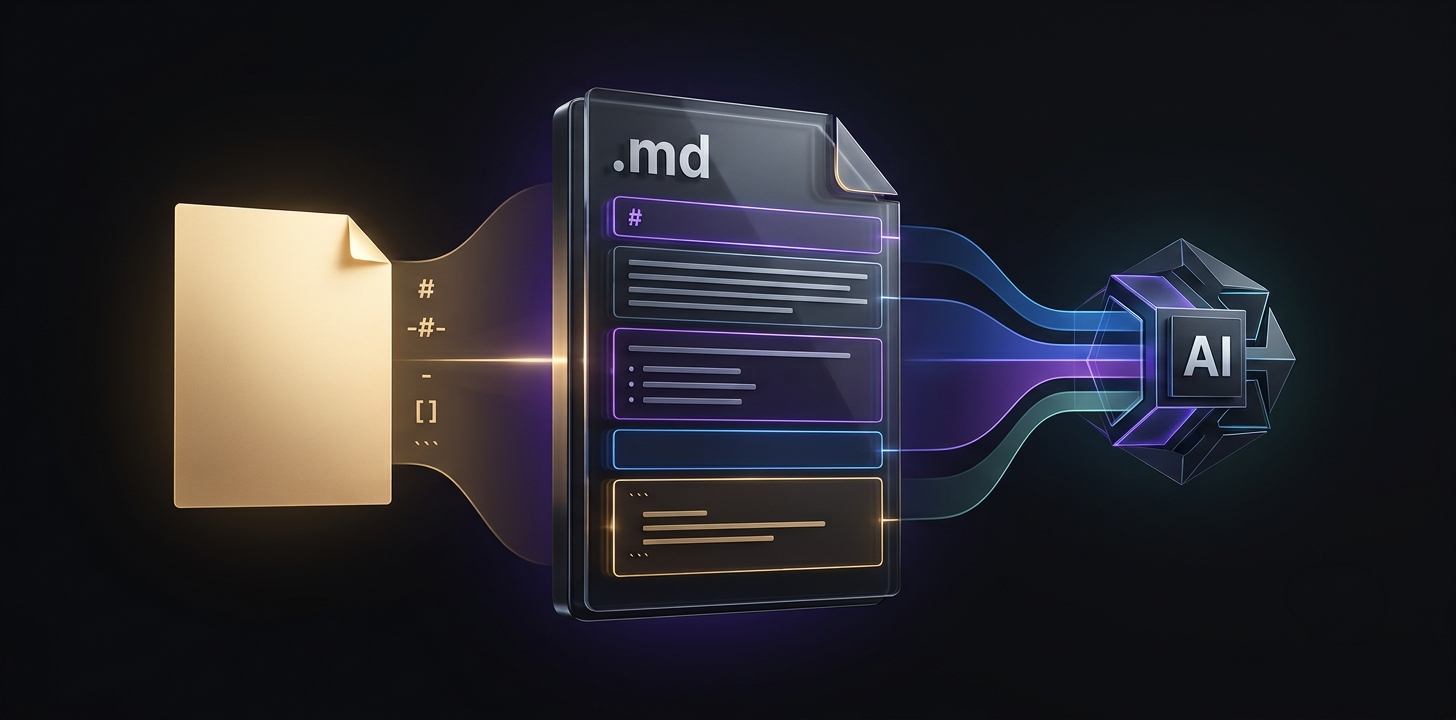
Markdown was created in 2004 for humans. Twenty years later, it quietly became the format AI models understand better than almost any other. Here is why that matters for anyone using AI professionally.
A quick note before we begin. I have put together a Markdown handbook that covers everything you need to write or edit a
.mdfile confidently. Read the article first — it will make the handbook more useful. Then use the handbook whenever you need it.
In the last three articles, we built the foundation.
- —AI is not thinking. It is predicting.
- —AI has no idea what you mean, only what you said.
- —The tools people build with have already moved past what was called vibe coding into something more disciplined.
Now we get to the practical file that changes everything.
It has an unusual origin story.
It was created in 2004 by two individuals who sought to simplify writing for the web. It was designed for humans. Twenty years later, without anyone planning for it, it quietly became the format AI models understand better than almost any other.
It is called Markdown. And you have almost certainly seen it, even if you have never named it.
What Markdown Actually Is
Markdown is a way of writing formatted text using plain characters.
That is the entire definition.
You use a # symbol to make a heading. You use two asterisks ** around a word to make it bold. You use a dash - to start a bullet point.
That is it. No software required. No special editor. Any text file works. Save it with the extension .md, and you have a Markdown file.
Here is what one looks like:
# My Project
This is a UX education platform for enterprise designers.

## What We Are Building
- A platform for real-world project practice
- A mentorship layer with industry practitioners
- A portfolio review system

## What We Are Not
- A generic course marketplace
- A theory-first curriculum
If you read that in your head right now, you already understand it. That is the entire point of Markdown. It appears the same whether you read it as raw text or as a formatted document. It was designed to be human-readable first.
Two people created it in 2004. John Gruber, and Aaron Swartz. Their goal was simple. Make writing for the web feel as natural as writing an email.
They succeeded more than they knew.
Markdown is everywhere in the software you already use. It is the language behind every GitHub README file. It is what Notion, Discord, and Stack Overflow all use as their base formatting.
Why AI Reads Markdown Better Than Anything Else
Every AI model was trained on billions of pages of text. A significant portion of that text — GitHub READMEs, documentation sites, developer wikis, and technical forums — was written in Markdown.
Ask any AI tool a question right now. Look at the reply. Headings. Bullet points. Bold text. Code blocks. It structures its answer in Markdown even though you never asked for it. This is not a design choice. It is the natural output of the training data.
Markdown is the format AI predicts in. Which is why it is the format AI reads best. When you give AI a document written in Markdown, headings tell it what section it is looking at. Lists tell it that items are related. Bold text tells it what matters most. The structure is right there in the text.
Compare that to a Word document or PDF. AI has to work harder to figure out what matters. Markdown removes that work.
Why This Matters for Anyone Using AI Professionally
This is the part that connects back to everything we have been building.
In Article 2, I wrote about the context problem. AI only knows what you explicitly tell it. In Article 3, I shared the research finding that AI agents with proper context files succeed at three times the rate of AI agents without them. Same tool. Same task. Different setup.
What is that context file written in?
Markdown.
Almost every AI-assisted development tool in 2026 — Claude Code, Cursor, GitHub Copilot, Gemini — reads Markdown files at the root of your project before it does anything else. Not because someone decided this arbitrarily. But because Markdown is the most token-efficient, machine-readable, and human-writable format that both parties in this relationship already understand fluently.
This applies far beyond writing code.
Whether you are a designer structuring a design system, a founder drafting product strategy, or a researcher synthesising interviews, a well-organised Markdown file with your constraints, conventions, and context will produce dramatically better AI output than the same information given as prose.
The tool understands structure. When you give it structure, it gives you back better output.
The Practical Shift
Most people using AI professionally are still doing everything inside the chat window. Typing prompts. Re-explaining the context every session. Starting from zero each time.
The practitioners getting consistently better results are doing something different. They keep structured Markdown files outside the chat — describing their project, preferences, constraints, and conventions. Then they let AI read those files before any conversation begins.
The chat window is where the conversation happens. The Markdown file is where the context lives.
Markdown itself is easier to learn than most people think. If you can write a bulleted list, you can write Markdown. To make it faster, I put together a Markdown handbook. Check it out.
This is Article 4 in the series AI From the Inside, a six-part series on AI literacy for designers, developers, and working professionals. Previous: Vibe Coding Is Already Over. Here Is What Replaced It.
Share this article
Related Articles
Agentic Engineering Is Not a Prompt. It Is a File System.
Learn how AGENTS.md, SKILL.md, DESIGN.md, tool-specific instruction files, and architecture decision records create reliable context for AI agents.
Vibe Coding Is Already Over. Here Is What Replaced It. And Why It Matters Even If You Are Not a Developer.
Vibe coding changed how software gets built, but agentic engineering is already replacing it. Here is why this shift matters for designers, founders, students, and anyone using AI tools.